- PROFESSIONAL MECHANICAL EQUIPMENT COMPONENT SUPPLIER -

Views: 0 Author: Site Editor Publish Time: 2026-10-22 Origin: Site

Are rising labor costs and inconsistent quality metrics hurting your bottom line? I have spent years on factory floors diagnosing production delays. More often than not, manual surface preparation acts as a hidden bottleneck. It quietly drains resources and slows down the entire manufacturing cycle. Balancing the need for a pristine surface finish with operational efficiency is a constant challenge for any facility manager.
Looking at current manufacturing trends, the surface treatment sector is undergoing a massive transformation. The chronic shortage of skilled operators is forcing a pivot toward Industry 4.0 standards. Facilities can no longer afford to treat surface profiling as an unpredictable, labor-heavy afterthought. Smart automation is now a baseline requirement. It is the only reliable way to maintain global competitiveness and safeguard profit margins against rising overhead.
From an engineering perspective, choosing the right blasting system requires comparing traditional manual methods with advanced automated solutions. By the end of this technical breakdown, you will have a clear framework for evaluating your facility's specific needs. This will help you make a strategic, data-driven purchasing decision.
Before securing budget approval for capital equipment, production engineers must grasp the fundamental mechanical differences between these two systems. Both methods serve the ultimate purpose of cleaning, deburring, or profiling a substrate. However, they execute the task in fundamentally different ways.
Manual sandblasting represents the traditional, hands-on method of surface preparation. In this setup, a human operator physically holds and directs a high-pressure blast nozzle at a workpiece. Depending on the size of the components, this process takes place inside a contained glove-box style blast cabinet or within a massive engineered blast room.
The defining characteristic of this approach is its complete reliance on human skill and physical endurance. To achieve the desired surface profile, the operator must continuously judge the correct standoff distance, impact angle, and dwell time. This offers an incredible degree of flexibility for intricate or highly unique geometries. Yet, it inherently introduces human variability into a process that demands strict standardization.
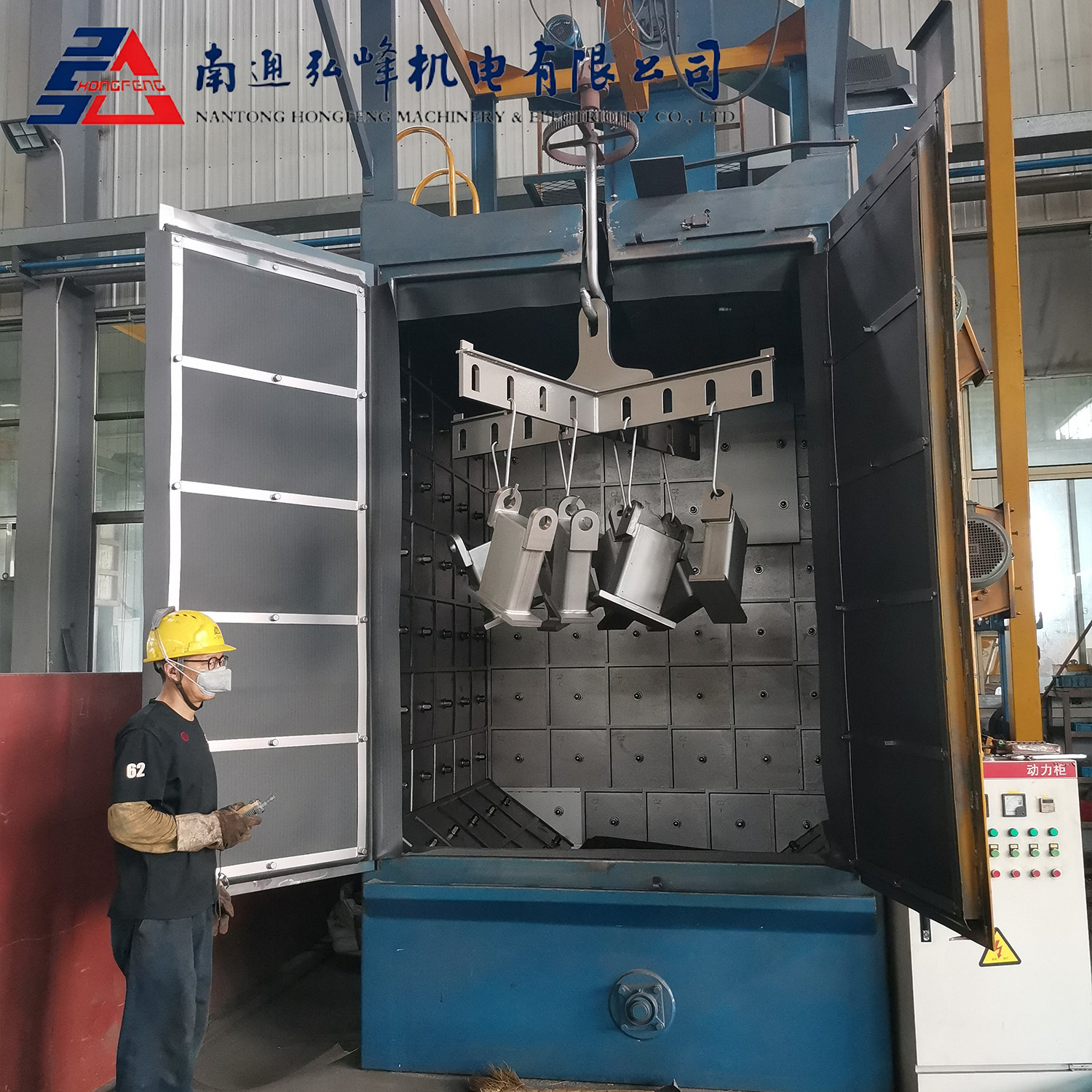
In contrast, automated systems completely remove the human element from the direct abrasive blasting process. These sophisticated machines utilize mechanized nozzle brackets, oscillating robotic arms, and automated part-handling mechanisms. The result is an impeccably uniform abrasive stream. Common industrial configurations include heavy-duty conveyor belt systems for flat panels, tumble blast machines for small batch parts, and rotary indexing tables for heavy or symmetrical components.
From a practical standpoint, modern automatic sandblasting machines are engineered to integrate seamlessly into existing manufacturing workflows. By utilizing Programmable Logic Controllers, production engineers can lock in precise parameters for air pressure, media flow rate, and conveyor transit speed. This ensures that whether you are processing the first part of the shift or the thousandth, every single component receives the exact same treatment.
To determine which system aligns with your operational goals, it is crucial to evaluate them across core manufacturing metrics. The table below outlines the stark contrasts in performance, consistency, and safety.
| Evaluation Metric | Manual Sandblasting | Automated Sandblasting Systems |
|---|---|---|
| Production Throughput | Slower. Heavily limited by operator fatigue and manual handling time. | High-speed continuous operation. Easily capable of processing hundreds of parts per hour. |
| Finish Consistency | Variable. Highly dependent on operator focus and physical stamina. | Perfectly uniform. Fixed angles and mechanized speeds guarantee a consistent Ra profile. |
| Labor Intensity | High. Requires a dedicated skilled operator for the entire duration. | Low. Requires only minimal supervision for loading, unloading, and recipe selection. |
| Flexibility | Excellent for custom, one-off, or highly complex geometric parts. | Best suited for repetitive, high-volume production of similar or identical components. |
| Operator Safety | Higher risk of ergonomic strain and exposure to dust hazards. | Enclosed systems completely isolate operators from noise, dust, and physical strain. |
The most immediate difference lies in throughput capacity. Manual blasting is inherently a disjointed batch process. An operator must open the cabinet, load the part, blast it, stop to visually inspect it, and then unload it. Holding a blast hose at 90 PSI for an entire shift inevitably causes muscle fatigue. Consequently, production speed naturally declines as the day wears on.
Furthermore, automated systems operate continuously. Parts can be fed onto a conveyor line or loaded into a rotary indexing table without pausing the blast cycle. This drastically reduces cycle times and eliminates the fatigue factor entirely.
In precision manufacturing, quality control dictates your scrap rate. This is especially true for lines preparing parts for high-adhesion powder coatings or sensitive plating. Manual blasting is vulnerable to human error. Even a slight variation in the nozzle distance can result in uneven surface roughness, leading to coating failures downstream.
Automated machines utilize precisely oscillating nozzle brackets. Once the optimal engineering recipe is programmed into the controller, the machine guarantees a uniform surface profile every single time. This level of repeatability drastically reduces the rate of rejected parts and costly rework.
For facilities experiencing rapid growth, transitioning from standard manual cabinets to automated solutions offers measurable business advantages. Implementing advanced automatic sandblasting machines directly addresses and eliminates common factory bottlenecks.
In many plants, surface preparation is the primary choke point that dictates the pace of the entire facility. Upgrading to an automated system shatters this constraint. Because automated machines process multiple components simultaneously, they accelerate the entire manufacturing cycle. This newfound speed allows downstream processes to operate at maximum capacity without sitting idle waiting for prepped parts.
Delicate parts, such as thin-walled automotive castings or aerospace brackets, require strict adherence to surface preparation tolerances. A manual operator might accidentally over-blast a sensitive area. This induces compressive stress that leads to part warping or unacceptable dimensional changes.
Specifically, automated systems provide engineering teams with surgical control. By regulating air pressure and media flow valves electronically, these machines ensure optimal surface treatment. They achieve exact roughness grades without ever damaging the underlying substrate.
Abrasive media represents a significant recurring operational expense. Manual blasting often results in higher media degradation rates because operators tend to use excessive application pressures. Modern automated systems are equipped with highly sophisticated media recovery and classification systems.
Integrated cyclones and heavy-duty dust collectors continuously separate reusable abrasive from pulverized dust. This closed-loop recycling process significantly lowers consumable purchasing costs while reducing the environmental footprint of your facility.
Despite the overwhelming benefits of automation, there are specific industrial scenarios where investing in automated equipment is not financially viable. Maintaining objectivity in your equipment selection means recognizing the enduring value of manual systems.
For job shops, custom fabricators, or specialized prototyping facilities, production runs often consist of unique one-off parts. These components frequently feature intricate internal cavities, deep blind holes, or highly variable geometries. Spending hours programming an automated machine for a single custom part is wildly inefficient. In these instances, the dynamic flexibility of a manual operator remains indispensable. They can visually inspect the cavity and adjust the blast angle on the fly.
Certain industries require surface preparation on massive objects that simply cannot be moved into a factory setting. Fixed automated machines are stationary by design. When dealing with rusted structural steel on a bridge or stripping the hull of a cargo ship, bringing a portable manual blast pot to the job site is the only feasible solution.
Selecting the appropriate surface treatment equipment requires a systematic evaluation of your specific manufacturing parameters. There is no universal solution. The optimal system must align seamlessly with your component specifications, facility constraints, and production strategy.
The physical characteristics of the components you manufacture dictate the exact type of material handling mechanism required.
For instance, small and durable components like fasteners, brackets, or cast fittings are highly effective in a tumble belt blast machine. These machines gently tumble bulk loads on a continuous rubber belt, exposing all surfaces to the blast stream simultaneously. Conversely, elongated components like steel plates or extruded aluminum profiles require a roller conveyor system. This passes the material linearly through a targeted blast chamber.
For complex, high-precision parts requiring diverse machinery parts surface treatment, a rotary table machine is the most appropriate choice. It secures individual parts on rotating fixtures to prevent mechanical collisions while ensuring 360-degree coverage.
Industrial floor space is a premium asset. Automated systems generally demand a larger footprint than manual cabinets. Facility managers must allocate space not only for the main blast chamber but also for the abrasive elevator, the oversized dust collector, and the material loading zones.
Adequate clearance around the machine is mandatory for maintenance personnel. In addition, ensure your facility possesses a robust industrial air compressor capable of delivering consistent, dry air at the high CFM volume required by multiple automated nozzles.
For some production lines, the immediate capital expenditure or lack of internal maintenance expertise makes purchasing in-house equipment impractical. If your production volume fluctuates seasonally, investing in a permanent automated system might not yield a favorable ROI.
In these scenarios, partnering with a reliable surface treatment provider is the most strategic alternative. Outsourcing allows facilities to leverage industrial-grade automation without the crushing overhead of ownership. Utilizing a professional Sand-Blasting service for diverse machinery parts surface treatment ensures strict quality compliance while maintaining lean internal operations.
Whether you operate a newly installed automated system or are optimizing an existing setup, adhering to engineering best practices is essential. Proper calibration directly impacts component quality and operational costs.
The efficiency of any blast operation is governed by the precise balance of compressed air pressure and abrasive media flow. A common misconception on the factory floor is that higher pressure always equates to faster cleaning. In reality, operating at pressures higher than necessary accelerates the breakdown of abrasive media, shattering it into useless dust.
This spikes consumable costs and overloads the dust collection system. Engineers should conduct empirical testing to determine the optimal parameters. Typically, running between 60 to 90 PSI for standard metals ensures efficient surface profiling while maximizing abrasive lifespan.
To maintain peak efficiency over the operational lifespan, a documented maintenance schedule is non-negotiable. The harsh nature of abrasive processing means internal components are constantly subjected to wear.
Routine inspections must focus intensely on the blast nozzles and air jets. As nozzles wear out, their internal diameter expands. This consumes significantly more compressed air and alters the blast pattern. Upgrading to highly durable materials like boron carbide nozzles extends maintenance intervals. Operators must also monitor the abrasive recovery system daily, pulsing the filter cartridges to maintain proper negative pressure.
Automated systems represent the ultimate solution for scaling production operations. They guarantee uncompromising quality consistency, drastically reduce cycle times, and lower your long-term operational costs by optimizing labor and media usage. While manual blasting will always hold value for custom or portable jobs, upgrading to automation is the definitive way to prevent bottlenecks in busy manufacturing environments.
Take the time to evaluate your current production line today to identify hidden inefficiencies. If you are looking to upgrade your factory floor, explore customized automatic sandblasting machines to meet your exact specifications. Do not let manual constraints hold back your manufacturing potential.
No, they are highly intuitive on a day-to-day basis. While the initial installation and mechanical calibration require technical expertise, modern systems feature user-friendly touchscreen interfaces. Once specific parameters are saved as a recipe, daily operation becomes standardized. The operator simply loads the parts, selects the correct program, and monitors the control panel.
It depends entirely on the specific application and the required surface finish. Shot blasting utilizes electrically driven centrifugal wheels to hurl heavy metallic media at high velocities. This makes it ideal for heavy descaling on large structural components. Automatic sandblasting uses compressed air to propel lighter media. It offers far greater control, making it the superior choice for precise, smoother finishes on delicate or complex parts where shot blasting would cause structural damage.
With strict adherence to preventative maintenance protocols, a high-quality automated system can easily last 10 to 15 years in a demanding production environment. The main structural enclosure is typically built from heavy-gauge steel lined with wear-resistant rubber or manganese alloy plates. The lifespan is maximized by promptly replacing consumable wear parts before they fail and allow abrasive to erode the permanent structural framework.
There are several clear indicators. If you are experiencing escalating labor costs due to multiple operators running manual cabinets across various shifts, automation will provide a rapid ROI. Additionally, if quality control is consistently flagging uneven part finishes, or if the manual station has become a severe bottleneck forcing downstream processes to wait, your current setup is actively limiting your growth.
Automated systems are highly versatile and can handle a wide range of media depending on the desired finish. Aluminum oxide is excellent for aggressive profiling and rust removal due to its hardness and recyclability. Glass beads are preferred for cosmetic finishing and deburring without altering part dimensions. The key is ensuring the machine's media recovery system is properly tuned to the specific weight and size of the chosen abrasive to maintain a clean, efficient closed-loop cycle.
Automation drastically improves coating adhesion by ensuring a perfectly uniform surface profile across the entire batch of parts. Powder coatings require a consistent anchor pattern to bond correctly. Manual blasting often leaves microscopic smooth spots due to uneven operator coverage, which leads to localized coating delamination. Automated nozzles maintain a fixed distance and angle, guaranteeing the exact surface roughness required for maximum mechanical bonding of the coating.