- PROFESSIONAL MECHANICAL EQUIPMENT COMPONENT SUPPLIER -

Views: 0 Author: Site Editor Publish Time: 2026-07-22 Origin: Site

Standardized metal finishes often work perfectly for general-purpose applications. However, commercial viability in OEM supply chains relies heavily on the exact specifications of the final surface layer. Procurement teams and lead engineers must look beyond the initial shaping of metal. Evaluating a manufacturing partner isn't just about cutting and bending. You must determine how the part survives its demanding end-use environment over time. If a component corrodes or degrades prematurely, it jeopardizes the entire product ecosystem.
This guide examines why specifying custom surface treatments is a critical decision-stage factor. We explore how selecting the right partner mitigates long-term warranty risks. You will learn how to evaluate a vendor’s finishing capabilities effectively. By prioritizing specialized coatings, you ensure components withstand harsh industrial realities. We will break down the business case for custom treatments. We will categorize various finishes based on their intended applications. Finally, we provide a robust framework for auditing potential vendors.
ROI on Durability: Custom surface treatments reduce total cost of ownership by preventing premature field failures and costly warranty claims.
Tolerance Management: Precision coatings require rigorous upfront engineering to account for tolerance stack-ups on critical mating surfaces.
Vendor Consolidation: Partnering with a factory that integrates or tightly manages finishing reduces supply chain bottlenecks and single-point-of-failure risks.
Compliance is Mandatory: Custom finishes must align with industry-specific regulatory standards (e.g., RoHS, REACH, FDA, or MIL-SPEC).
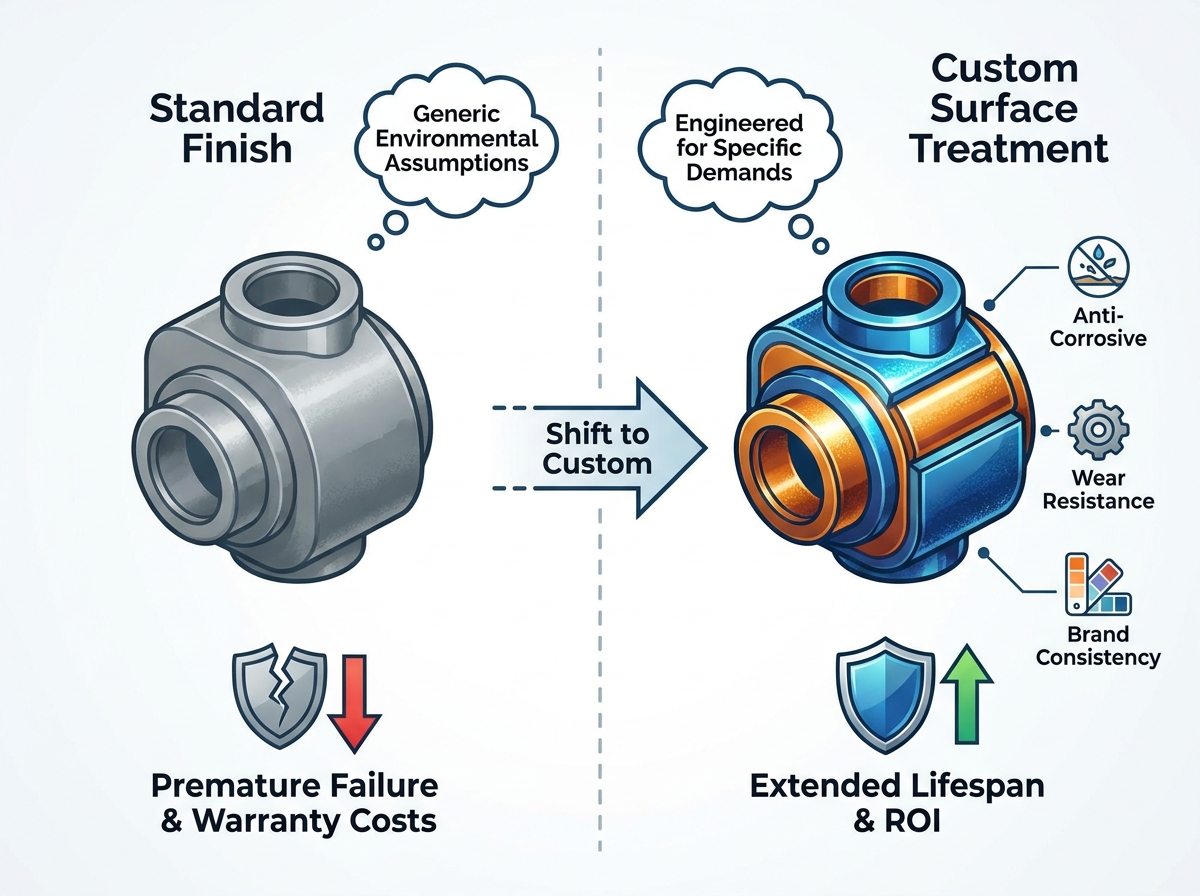
Standard finishes like basic zinc plating or standard powder coating assume generic environmental conditions. These off-the-shelf treatments rarely match the extreme realities of industrial applications. Engineers often specify them to save upfront costs. This approach creates unseen vulnerabilities. When you deploy parts into highly corrosive, high-friction, or chemically aggressive environments, standard coatings break down rapidly. The financial impact of such failures is severe.
Consider the cost of corrosion, galling, or cosmetic degradation on high-volume production runs. When a batch of oem sheet metal components fails in the field, the consequences multiply. You face direct replacement costs. You also absorb labor expenses for field repairs. Brand reputation suffers immense damage. Warranty claims skyrocket. These expenses quickly dwarf any initial savings gained from choosing a cheap, generic finish. Furthermore, frequent part replacements disrupt your customer's operations. This leads to lost contracts and diminished market trust.
A successful surface treatment strategy requires a fundamental mindset shift. Procurement teams must move away from calculating the lowest cost per part. Instead, they must focus on achieving the lowest failure rate per batch. Custom finishing engineered for your specific use case provides a robust defense mechanism. It protects the base alloy from environmental stressors. We see this constantly in aerospace, medical device, and heavy machinery manufacturing. In these sectors, standard finishes simply cannot meet the required performance thresholds.
Galling occurs when two metal surfaces rub together under heavy loads. Standard finishes often lack the necessary lubricity or hardness to prevent this localized welding. Custom dry film lubricants or engineered plating resolve this issue entirely. Similarly, standard zinc plating might resist rust in a controlled indoor facility. It will fail quickly in marine environments or chemical processing plants. Upgrading to a specialized finish ensures your components perform reliably, regardless of where they operate. You must align the coating properties directly with the environmental hazards your product faces daily.
Engineers must categorize treatments based on their primary performance outcome. Simply looking at the chemical process is rarely enough. A sophisticated oem metal fabrication factory categorizes finishes by the exact problem they solve. This application-driven selection process guarantees optimal results. It prevents engineers from choosing a finish based solely on habit.
Many components face aggressive environments daily. Prolonged salt-spray exposure, extreme humidity, or chemical washdowns demand robust defense layers. Advanced Type III hardcoat anodizing offers exceptional corrosion resistance for aluminum parts. It alters the molecular structure of the surface, creating an incredibly hard barrier. Specialized powder coatings provide thick, durable barriers for steel assemblies. These can incorporate UV inhibitors to prevent chalking under intense sunlight. Galvanizing processes can be explicitly tailored to meet required salt-spray exposure hours. Choosing the right anti-corrosive finish extends the functional life of the base metal exponentially. It stops oxidation before it compromises structural integrity.
Moving structural components require entirely different surface characteristics. Here, reducing friction and preventing mechanical wear are top priorities. Hard chrome plating provides extreme surface hardness. It resists abrasion incredibly well in hydraulic cylinders and gear shafts. Electroless nickel plating offers excellent lubricity and uniform thickness across complex geometries. Unlike electrolytic processes, it coats deep recesses evenly without edge buildup. Dry film lubricants prevent galling on threaded fasteners or sliding rails. These treatments are essential for internal mechanisms where metal-on-metal contact is unavoidable. They reduce maintenance intervals and improve mechanical efficiency.
Visual appeal matters, even in industrial environments. Consistency across batches builds brand trust. Customers often judge the internal quality of a machine by its external appearance. Custom color matching ensures your components align perfectly with corporate branding. Gloss retention keeps parts looking new despite prolonged exposure to the elements. Tailored texture profiles can hide fingerprints or provide better grip for end-users. When specifying custom metal fabrication parts, never overlook the cosmetic impact of the final finish. A high-quality coating communicates premium manufacturing standards instantly.
Below is a quick reference chart summarizing these primary treatment categories:
Primary Outcome Category | Typical Treatment Processes | Ideal Application Environments |
|---|---|---|
Anti-Corrosive Protection | Type III Anodizing, Specialized Powder Coat, Custom Galvanizing | Marine, chemical plants, high-humidity zones |
Mechanical Wear Resistance | Hard Chrome, Electroless Nickel, Dry Film Lubricants | Gears, sliding rails, threaded mating surfaces |
Cosmetic Consistency | Custom Color Matching, Textured Coating, UV-Resistant Plating | Consumer-facing panels, branded equipment housings |
Selecting the right manufacturing partner requires diligent evaluation. You cannot blindly trust a vendor to handle your surface finishes. You need a structured decision framework to assess their capabilities accurately. Superficial checks often lead to disastrous production outcomes.
Batch-to-batch repeatability is the hallmark of quality manufacturing. How does the factory ensure consistent results every time? Look for automated line monitoring systems. These systems track temperature, voltage, and immersion times continuously. Human error is minimized when software manages these critical variables. Documented bath chemistry controls are equally critical. Plating baths degrade over time as chemicals deplete. If a vendor cannot provide logs of their chemical maintenance, they cannot guarantee consistent plating thickness or adhesion. Ask to see their titration schedules and chemical replenishment protocols.
A beautiful finish quickly peels off a poorly prepared substrate. The final coating is only as good as the surface preparation beneath it. Evaluate their mechanical and chemical pre-treatment standards rigorously.
Mechanical Preparation: Do they use media blasting to create an ideal surface profile? A roughened surface provides better mechanical adhesion for paints and powders.
Chemical Preparation: Are their degreasing and acid etching protocols up to industry standards? Oils, coolants, and mill scale must be completely removed.
Handling: Do they enforce strict clean-room protocols between prep and plating stages? Airborne contaminants can ruin a batch before it even enters the plating tank.
Skipping or rushing these steps leads directly to field failures. Flaking, blistering, and under-film corrosion usually point back to rushed pre-treatment.
Never rely on visual inspections alone. A part might look perfect while masking underlying defects. Reputable vendors provide verifiable, empirical data. Expect to see comprehensive destructive and non-destructive testing reports.
Cross-Hatch Adhesion Testing: Confirms the coating bonds securely to the base metal. A blade scores the finish, and aggressive tape tests the bond strength.
Mil-Thickness Measurements: Ensures the coating meets the precise dimensional requirements specified. Eddy current or magnetic gauges provide instant feedback.
Spectrometry: Verifies the exact chemical composition of the deposited layer. This is vital for alloys demanding precise material properties.
Best Practices: Always request sample coupons before approving a full production run. Subject these coupons to independent lab testing to verify the vendor's internal QA data.
Common Mistakes: Accepting a lower quote without auditing the vendor's pre-treatment processes. Poor prep work is the leading cause of premature coating delamination.
Specifying a custom finish is not just a procurement task. It involves significant engineering challenges. Failing to account for these realities during the design phase causes massive assembly headaches later. Engineers must bridge the gap between theoretical CAD models and physical manufacturing constraints.
Coatings add physical material to your parts. This added thickness alters the final dimensions. Engineers must calculate for pre-plating and post-plating dimensions meticulously. If you specify a tight tolerance for a bearing press-fit, adding two mils of electroless nickel will make assembly impossible. You must communicate dimensional requirements clearly to your finishing partner. They need to know which dimensions apply before the coating goes on, and which apply after. Plating builds up more on sharp corners than in flat areas. This phenomenon, known as edge buildup, must be accounted for in your initial design. Adding slight radiuses to corners often mitigates this issue effectively.
Sometimes, you only want the finish on specific areas. You might need to keep critical internal threads bare to maintain proper torque specifications. You might require specific grounding points to remain unpainted for electrical conductivity. This process is called masking. Masking is notoriously difficult and labor-intensive. It requires custom silicone plugs, specialized tapes, or machined fixtures. It highlights the need for highly experienced labor and tight quality assurance. If masking tape lifts during a chemical bath, the entire part is ruined. Integrating high-quality industrial surface treatment services requires careful planning around these selective finishing zones. Always design parts to minimize complex masking requirements whenever possible.
Many fabrication shops outsource their finishing operations. This creates inherent supply chain risks. If your manufacturing partner sends parts to a third-party coater, how do they manage the logistics? Transit introduces significant risks of part damage. Scratches and dents occur easily during loading and unloading. Outsourcing also extends lead times considerably. You must evaluate whether the factory offers in-house finishing or relies on a certified vendor network. In-house capabilities often streamline production and improve quality control significantly. If they do outsource, demand transparency regarding how they audit their secondary suppliers. Ask about their defect resolution process when a subcontractor ruins a batch.
You have established your technical requirements. You understand the engineering risks involved. Now, you must shortlist potential manufacturing partners based on strict audit criteria. This final evaluation separates capable partners from high-risk vendors.
Industry compliance is non-negotiable in modern manufacturing. Verify the vendor holds current certifications relevant to your specific sector. An ISO 9001 certification demonstrates baseline quality management practices. However, many industries require much more stringent oversight. Are they compliant with RoHS (Restriction of Hazardous Substances)? This is critical for electronics and consumer goods. Do they meet REACH regulations for the European market? Aerospace and automotive applications often require specialized NADCAP or IATF certifications. Request these documents upfront. Do not accept expired or pending certificates. Validating these credentials protects your company from regulatory fines and product recalls.
In modern manufacturing, traceability protects you from severe liability. Demand clear, comprehensive documentation for every batch produced. Require First Article Inspection (FAI) reports for all new parts. Use the Production Part Approval Process (PPAP) to ensure sustained quality over time. These documents must detail the exact chemical makeups used. They should also record the specific process parameters, such as curing temperatures and bath durations. This data trail is invaluable if field troubleshooting becomes necessary later. It allows engineers to trace a failure back to a specific plating batch or date.
Do not jump straight into a high-volume production contract. Your next step should always involve a limited pilot run. Request prototype testing to validate their precision metal finishing services. A controlled pilot run allows you to assess their communication skills, quality control processes, and adherence to lead times. Evaluate the prototype parts rigorously against your engineering drawings. Perform adhesion tests and dimensional checks immediately. Only commit to larger production volumes once the pilot passes all functional and cosmetic tests. This methodical approach minimizes financial risk dramatically.
Selecting the right custom finish is just as vital as choosing the correct base alloy. An OEM’s reputation literally rests on the surface of its products. If the finish fails, the customer perceives the entire product as defective, regardless of internal quality. We must look far beyond basic metal shaping capabilities when choosing a vendor. A true manufacturing partner proactively engineers the surface treatment. They work alongside your design team to extend the component's functional lifespan. They help you navigate the complexities of tolerance stack-ups and regulatory compliance seamlessly. Audit your current component failure rates today. Identify specific areas where standard finishes are falling short of expectations. Then, consult with a technical sales engineer to specify the optimal custom finish for your next production run. Upgrading your finishing strategy is a proven, reliable path to enhanced product durability and long-term market success.
A: Standard powder coating utilizes stock colors and generic resin bases designed for general environments. Custom powder coating involves engineered mil-thickness requirements. It uses specific UV-resistant or chemical-resistant formulations tailored to your exact application. Furthermore, custom processes often involve highly tailored curing cycles to ensure maximum adhesion under extreme conditions.
A: It can, especially if the finishing process is outsourced to a third-party vendor. Integrating specialized finishes usually requires an extra 3 to 7 days depending on masking complexity and batch size. However, partnering with a vendor that handles fabrication and finishing in-house minimizes transit delays and streamlines schedules.
A: Different treatments affect dimensions uniquely. Processes like Type III anodizing penetrate the aluminum while building up on the surface. Conversely, powder coating or plating only adds material thickness to the outside. Engineering drawings must explicitly state whether the specified dimensions apply "pre-finish" or "post-finish" to ensure proper final assembly.